A Tour & Interview from Amami Park

Just off the coast in the Kasari area of Amami City, Amami Park is a large hall celebrating and teaching the island's rich heriage, as well as offering travel info, shopping, and delicious local cuisine.
Conveniently acessible within minutes from Amami Airport, and in driving distance from downtown Amami City, it's a must-see whether you just arrived, or are looking for a spot to visit along the island's picturesque northern coast.
The Facilities

The main hall provides event space for locals and travellers alike, with cultural events often calling this space home throughout the year.
On a clear day, Amami's natural sunlight brightens the room through the uniquely-designed ceiling.

Key attractions include an exhibition displaying Amami's rich natural and cultural heritage, including a model forest where you can meet some of the island's flora and fauna.

Perhaps most impressive among these is a village recreation, modelled after small island towns in the 1950s-60s, displayed in incredible detail and with plenty of cultural insights.

Also in the main hall are a series of large dioramas; you can explore all of the islands in the Amami Archapelago. Examine their topography from above, or use the digital terminals to view famous sites and plan your next trip.
Also located in the main hall is a second-floor restaurant, serving delicious island fare.

Just next door is the Tanaka Isson Memorial Museum, an art museum celebrating the works of the titular artist who lived in Amami for nearly twenty years, and painted its beautiful scenery. His prolific works from his time both on the island and the mainland are displayed here, with roughly 80 of the museum's 100 pieces on display at any given time. Stop by often to see the whole collection!
The museum's unique spin on traditional island architecture consists of several raised buildings overlooking a shallow pond. The scenery outside is beautiful enough to make the windows just as much of an attraction as the paintings.
An Interview with the Team
While taking a look at what the park itself has to offer, we also sat down with three of the park's staff, and asked about their experienced on the island, and travel advice for your next visit! For this interview, we'll call them:
Sensei, a knowledgable and seasoned island resident, is a Kagoshima native who's lived on the island for over 40 years.
Ani, a younger staff member, is also originally from Kagoshima and enjoys visiting the island's coast.
Ane is an Amami native: living in Kasari, she enjoys travelling to the south and visiting spiritual hotspots.
For you, what's the most interesting part of Amami's culture?
Ani: Hmm… Hachigatsu-odori dancing? (Laughs),
Well, in Tatsugo they hold the Shochogama festival. I went to see it myself, years ago.
EA: You didn’t need to sign up or anything?
Ani: Nope, you can just go. It started at around 5 AM: as the sun rises, they bring the
building down.
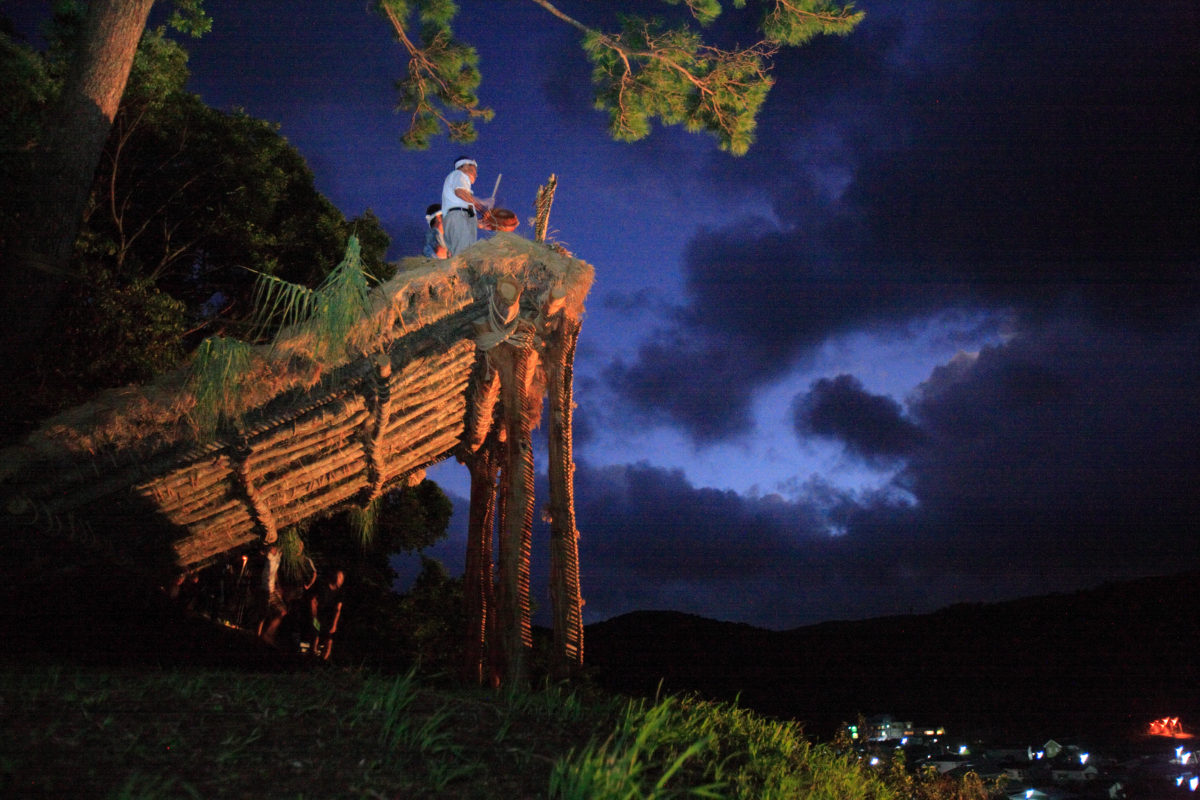
Raised bamboo and thatch platform used in Shochogama: a ritual performed annually in the late summer to give thanks for the year's harvest, and to pray for the next one. Local men gather onto the roof of the platform, and it's brought down when the sun rises.
EA: Isn’t it scary when you fall?
Ani: The locals are the ones who stand on top, but I could stand below, on the ground… I was fine. (laughs)
Sensei: And each region – each village – has its own unique festivals. Long ago, there
weren’t any tunnels, and so movement between villages wasn’t easy: as a result, each one had its culture develop independently.
What makes Amami different from other parts of Japan?
Sensei: All around Japan, populations are shrinking, and … generally, when you you go to the
countryside, the population is aging, and traditions aren't being maintained. In Amami, a lot of young people return home, and keep the traditions going… The relationships between people and their towns are tight-knit, and there’s some local pride, too. … which I feel is quite strong.

A sunny afternoon in the small town of Kominato, Amami City.
Ani: Here on the island, when speaking to someone older, you call them "ani" or "ane",*
right? Back in Kagoshima, if you went really far into the country, you’d hear it. But it was
more of a term for relatives; on Amami, it’s different, you know? Even at City Hall, you’d call
your older coworkers "ani", and so on. It’s like islanders have a close connection with each
other.
* [In Japanese, name enders are a common way of addressing another person. These usually take the form of the person's last name, followed with "san,", "chan," "sama," etc., depending on the relationship you have with them. On Amami, these are all used, but the island has a unique way of addressing those older and/or in a higher status. Instead of using the person's last name, take their first name and add "ani" for men, "ne", for women.
[Example]
Takeshi = Takeshi-ani
Sakura = Sakura-ne
These come directly from the words "ani" (older brother) and "ane" (older sister), reflecting the friendliness of the islanders and their close ties with one another.
When you visit Amami, give these words a try when you meet a local. They'll be surprised you know a part of their dialect!]
As you know, Amami is a pretty big island. For you, what's the most interesting area?
Ani: Area… that’s a tough one… (laughter) Well, I love the ocean. I can’t swim, but I love seeing it; so anywhere is great. Anywhere you go on the island, you can see the sea, and the scenery around is different across the island. So I really can’t say which area is my favourite.

East China Sea seen from Ohama park: Naze, Amami City.
Sensei: I love the sea too… the East China Sea seen from Akina, in Tatsugo Town, is really unique. It goes on forever. Going across the mountains, compared to the Pacific side, it’s quite different. Also, when you go from Naze to Sumiyo, the scenery really changes when you pass through, and I find it really interesting.
Ane: I really love the south. When it comes to driving routes - well, I live in Kasari (in the north), so I’m always going south - I like going there. I’m also interested in spirituality... and so going to the south, being in the forests and seeing old stone monuments... it has this amazing, mysterious atmosphere.
EA: That's amazing. So, for someone visiting who wants to see one of these sites, where would you recommend?
Ane: There’s really so many in the south… in Ankyaba (Tatsugo Town), there’s a shrine high up - Imai Daigongen shrine.
Sensei: They say at night, you really shouldn’t go there. (Laughs)... that’s not your average travel destination, it's a deep travel spot!
Finally: What advice would you give to someone travelling to Amami for the first time?
Ani: Really depends on the seasons…
Ane: If it’s in the summer, the locals would be very happy to have you join in the Hachigatsu-Odori (August Dance).
Ani: In summer, there’s the ocean, like I said, and also local festivals.
But there’s also so much nature, so… cycling? Now it's February, and sakura is blossoming: and biking along the roads they bloom can be really nice.

Sakura bloom above Takachiho Shrine: Ongachi, Yamato Village.
EA: So it’s best to choose what kind of experience you want, and plan the season around that.
Sensei: I feel the same way, that adjusting around season - and age - are important. Last year, an acquaintance of mine visited Amami during the summer, but wasn’t very interested in summer leisure. Coming instead in the cooler months, he rented a car, and enjoyed driving around the villages and enjoying their cuisine.
I think driving around the island and strolling around the towns can make for a good experience. Tachigami,* Kami-michi**, areas for Hachigatsu-Odori dancing... It may take some time, but I think learning about this history and Amami’s folk religion can be a really interesting experience for visitors from abroad.
[*Tachigami are large rocks jutting out from the sea near several Amami settlements, traditionally thought to be where gods from beyond the island first stop when visiting.
**Kami-michi in traditional Amami villages are roads descending from the mountain, often connecting to the town shrine, symbolizing a place for the gods - who live high in the mountains - to descend to the human settlement. ]
Ane: Something I felt you can only see in Amami was that, in the north, you have Catholic churches and cemeteries next to them, and that Christianity can seem more common than even Buddhism. In the south, another kind of scenery only found here is in places formed by nature, where you have the ocean to your left, and the mountains immediately to your right, such as Honohoshi Coast in the south.
Amami Park is the perfect place to stop on the island: learn about its history, nature, and culture; view artwork in a serene art gallery, and get inspiration for where to go next on your adventure in Amami Oshima.
WRITER
- 【More Info on Amami Park】
- Amami Park Website
- 【Amami Park Location 】
- Google Maps
- 【Akina, Tatsugo Town 】
- Google Maps
- 【Imai Daigongen Shrine 】
- Google Maps
- 【Honohoshi Coast 】
- Google Maps